
Free Boiler Grants for Old, Inefficient Boilers
If your home has an old boiler installed before 2005, you may qualify for a brand-new A-rated condensing boiler at no cost through government-backed grant funding. We help households across Berwick-upon-Tweed to York, coast to coast.
Check my eligibility Call 0800 246 8135
Replacing a tired, inefficient boiler is one of the most effective ways to cut your heating bills and keep your home warm. Through national energy-efficiency schemes, eligible households can have their old boiler replaced with a modern, high-efficiency model — often fully funded.
To qualify you must already have an old boiler. The grant exists to remove the least efficient heating systems from the UK's housing stock, so a working modern combi that is only a few years old will not be eligible. If your boiler is an open-flue conventional unit, a back boiler behind the fire, a bulky floor-standing model, a non-condensing wall-hung boiler, an older combi, or an ageing oil boiler, you are exactly the kind of household these schemes are designed to help.
How the free boiler grant works
The process is straightforward and designed to be low-stress. There is no hard sell and no obligation to proceed.
- Quick eligibility check. Tell us a little about your household, your benefits status and your existing boiler. It takes around a minute.
- Free home survey. If you look likely to qualify, a registered surveyor visits to confirm your boiler type and check the installation.
- Funded installation. Where funding is approved, a Gas Safe registered engineer fits your new A-rated boiler and removes the old one.
- Warmer home, lower bills. You enjoy reliable heating and hot water, with running costs that are typically far lower than an old boiler.
Which old boilers qualify?
We specialise in the boiler types that grant schemes most want to replace. Each of the pages below explains how to recognise the boiler, the common faults it develops, and why a modern replacement makes such a difference.
Open-flue (conventional) boilers
Heat-only boilers paired with a hot-water cylinder and loft tanks, drawing air from the room.
Older combi boilers
First-generation combis from the late 1990s and early 2000s, now well past their best.
Why replace an old boiler?
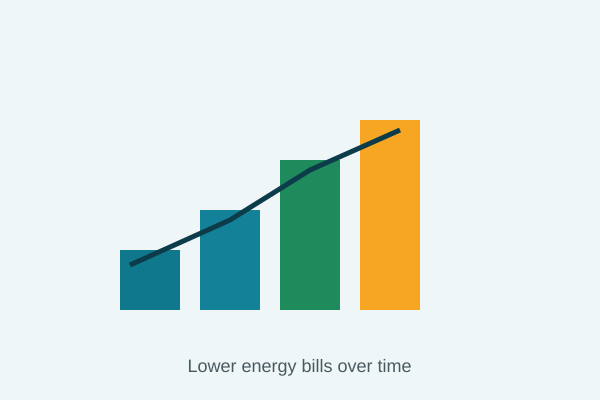
Heating accounts for well over half of the average British home's energy use, and an old boiler is usually the biggest culprit. A non-condensing boiler from the early 2000s might run at around 65–70% efficiency, meaning roughly a third of the gas you pay for is lost up the flue. A new A-rated condensing boiler recovers much of that wasted heat and can operate at over 90% efficiency. The difference shows up on every bill, through colder months especially.
Beyond the savings, there is reliability and safety. Older boilers break down more often, parts become scarce, and worn components can present a carbon-monoxide risk if a flue or heat exchanger fails. A new boiler comes with a manufacturer's warranty, modern safety features and far better controls, including the option of a smart thermostat that learns your routine.
You can read more in our guides on the common problems with old boilers and how to tell if your boiler counts as old.
Local heating help across the North
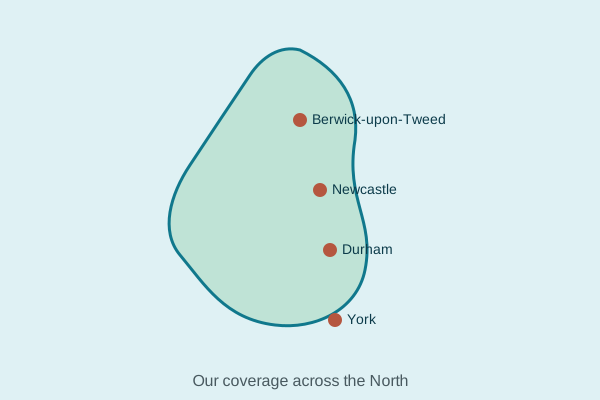
We are a North East team and we cover a large patch — from Berwick-upon-Tweed to York, coast to coast. That includes the major cities and the many market towns, mining villages and coastal communities in between. Wherever you are between the Scottish border and York, from the Cumbrian coast across the Pennines to the North Sea, there is a good chance we can help. Browse all the areas we cover to find your town.
Knowing the region matters. Much of our older housing — Tyneside flats, pit-village terraces, Victorian stone cottages and post-war council builds — was fitted with exactly the boiler types these grants target. Many still rely on back boilers or heat-only systems that have soldiered on for decades. If that sounds like your home, the first step costs nothing but a minute of your time.